
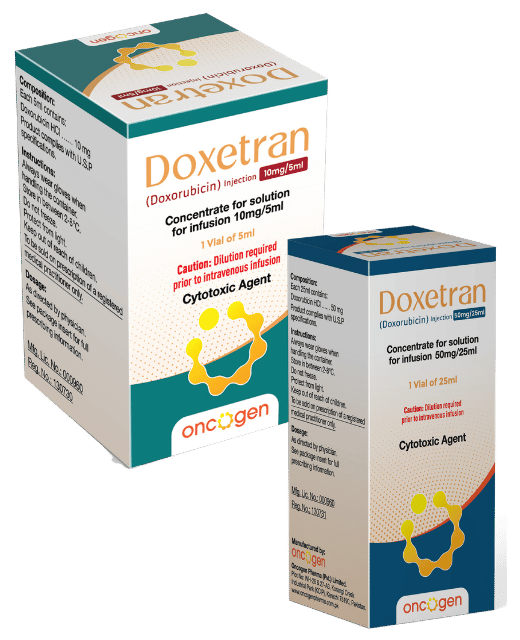
Doxetran (Doxorubicin) — Decades of Trust. Available in 10mg/5mL and 50mg/25mL.
Chemotherapy Injectable

Doxetran (Doxorubicin)

Available strengths

  • 50mg/25mL
  • 10mg/5mL
Doxetran (doxorubicin) product packs in 50mg/25mL and 10mg/5mL strengths

Patient Information

Frequently Asked Questions (FAQs)

Doxetran is a prescription medicine that contains the active ingredient doxorubicin (an anti-cancer, or cytotoxic, medicine of the anthracycline group). It is used to treat certain types of cancer, and may be given alone or together with other anti-cancer medicines. Doxetran is given as an infusion into a vein — it is not taken by mouth.

Doxetran can cause serious problems that your healthcare provider will watch for closely:

  • Heart problems (cardiomyopathy and heart failure). Doxetran can damage the heart muscle. The risk goes up the more Doxetran you receive over time (the total, or cumulative, dose), and is higher if you have had radiation to the chest or other medicines that can affect the heart. Your doctor will check how well your heart is pumping (for example with an echocardiogram or a MUGA scan) before, during, and after treatment. Heart problems can appear during treatment or months to years later. Tell your doctor about shortness of breath, swelling of your ankles or feet, rapid weight gain, or a fast or irregular heartbeat.
  • New (secondary) cancers. A small number of people treated with anthracyclines such as doxorubicin have later developed a blood cancer, such as acute myeloid leukemia (AML) or myelodysplastic syndrome (MDS).
  • Severe drop in blood cell counts (myelosuppression). Doxetran can seriously lower your blood cells. This can lead to serious infection, septic shock, the need for blood transfusions, hospitalization, and, rarely, death. Your blood counts will be checked regularly. Tell your doctor right away about fever, chills, or other signs of infection, or unusual bleeding or bruising.
  • Injury if the medicine leaks from the vein (extravasation). If Doxetran leaks out of the vein into the surrounding tissue, it can cause severe tissue damage that may need surgery. Tell your nurse right away if you feel burning, pain, redness, or swelling at the infusion site during your infusion.

Before you receive Doxetran, tell your doctor about all of your medical conditions and all the medicines you take, including if you:

  • Have heart problems, including heart failure, or risk factors for heart disease;
  • Have had, or are going to have, radiation to the chest;
  • Have had treatment with other anthracycline medicines (such as doxorubicin, daunorubicin, epirubicin, or idarubicin) or other medicines that can affect the heart (such as trastuzumab) — these add to the risk of heart problems;
  • Have liver problems — your dose may need to be lowered;
  • Have an infection, or have low blood cell counts;
  • Have ever had an allergic reaction to Doxetran (doxorubicin);
  • Have gout or a high level of uric acid in your blood;
  • Are pregnant, could become pregnant, or are breastfeeding — Doxetran can harm an unborn baby and must not be used during pregnancy or breastfeeding.
    • Women who can become pregnant should avoid becoming pregnant and use effective birth control (contraception) during treatment; your doctor will advise how long to continue it afterwards;
    • Men should use effective birth control (contraception) during and after treatment;
    • Do not breastfeed during treatment with Doxetran.

Doxetran can also affect fertility. In women, monthly periods may stop during treatment and usually return within a few months. In men, sperm production may be reduced or absent, and this can sometimes be permanent. If having children in the future is important to you, discuss options such as sperm storage with your doctor before starting treatment.

  • Doxetran is given into a vein through an intravenous (IV) line by your healthcare provider.
  • Your healthcare provider will do blood tests to check for side effects during treatment, and heart tests (such as an echocardiogram or MUGA scan) to check your heart function before and during treatment.
  • Your healthcare provider may stop your treatment, change its timing, or change your dose if you have certain side effects, or lower your dose if you have liver problems.
  • Your urine may turn red or orange for a day or two after each dose. This is caused by the color of the medicine and is harmless.

Serious side effects

Tell your doctor or healthcare provider right away or get emergency medical help if you have any of the following:

  • Heart problems. Tell your doctor about shortness of breath, swelling of your ankles or feet, rapid weight gain, or a fast or irregular heartbeat.
  • Severe drop in blood counts and serious infections. Tell your doctor about fever, chills, or other signs of infection, or unusual bleeding or bruising.
  • Injury where the medicine leaks from the vein (extravasation). Tell your nurse right away about burning, pain, redness, or swelling at the infusion site.
  • Severe allergic reactions. Get medical help right away for an itchy rash or hives, swelling of the face, lips, or throat, trouble breathing, or feeling faint during or after the infusion.
  • Severe mouth sores (mucositis / stomatitis). Painful sores in the mouth or throat that can make eating and drinking difficult. Tell your doctor if they are severe.
  • Serious stomach or bowel problems. Get medical help for severe stomach (abdomen) pain, black or bloody stools, or vomiting blood.
  • Hand-foot syndrome. Redness, swelling, tingling, pain, or peeling of the palms of your hands and the soles of your feet. Tell your doctor if this starts.
  • New (secondary) cancers. Your doctor will monitor you over time.
  • Harm to an unborn baby. Doxetran can harm an unborn baby. Tell your doctor if you are pregnant, could become pregnant, or are breastfeeding.

Common side effects

These may include:

  • hair loss (alopecia)
  • nausea and vomiting
  • diarrhea
  • mouth sores (mucositis)
  • loss of appetite
  • tiredness or weakness
  • fever or chills
  • darkening of the skin or nails
  • rash or hives
  • red or watering eyes (conjunctivitis)

This is not a complete list of side effects. Tell your doctor about any side effect that bothers you or does not go away.

For further information

This page answers common questions about Doxetran. It is for general information only and does not replace advice from your doctor. For complete details, including all warnings, precautions, and side effects, please review the product prescribing information above.

Need more information about Doxetran?

Share your product inquiry with the Oncogen Pharma team. We will respond with relevant information for formal healthcare, partnership, or product availability discussions.

Get in Touch