
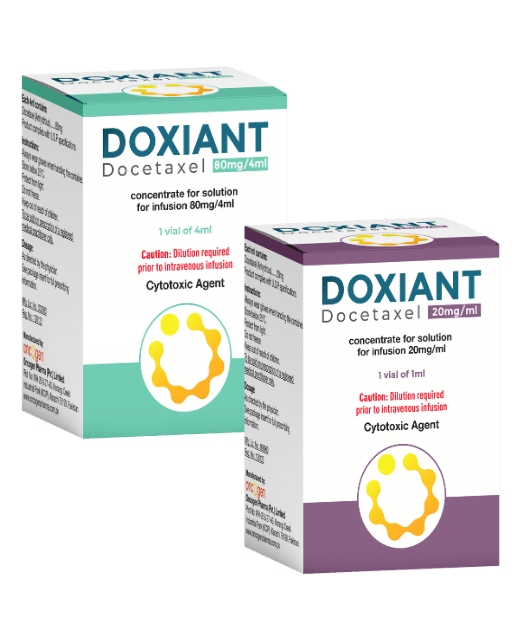
Doxiant Docetaxel — Prescription anticancer medicine. Available in 80mg/4mL and 20mg/mL.
Chemotherapy Injectable

Doxiant (Docetaxel)

Available strengths

  • 80mg/4mL
  • 20mg/mL
Doxiant (Docetaxel) product packs in 80mg/4mL and 20mg/mL strengths

Patient Information

Frequently Asked Questions (FAQs)

Doxiant is a prescription anticancer medicine used to treat certain people with:

  • Breast cancer
  • Non-small cell lung cancer
  • Prostate cancer
  • Stomach (gastric) cancer
  • Head and neck cancer

It is not known if Doxiant is safe and effective in children.

Docetaxel can cause several serious problems that your healthcare provider will watch for closely:

  • Severe allergic (hypersensitivity) reactions. Docetaxel can cause severe hypersensitivity reactions, including life-threatening or fatal anaphylaxis. These reactions can occur even when dexamethasone premedication is given. Severe reactions require immediate discontinuation of Docetaxel and appropriate treatment. Docetaxel should not be given to patients with a history of severe hypersensitivity to Docetaxel or to medicines formulated with polysorbate 80.
  • Low white blood cell counts (neutropenia). Docetaxel can cause neutropenia, which can increase the risk of serious infections. Docetaxel should not be administered to patients with a neutrophil count below 1500 cells/mm³. Your doctor will perform frequent blood counts to monitor for neutropenia.
  • Liver problems (hepatotoxicity). Docetaxel can cause serious liver-related complications. The risk is increased in patients with abnormal liver function. Liver function tests (LFTs) should be obtained before each treatment cycle. Docetaxel should be avoided in patients with certain significant liver function abnormalities.
  • Severe fluid retention. Docetaxel can cause severe fluid retention, including swelling and accumulation of fluid in the body. This may occur despite dexamethasone premedication.
  • Increased risk of treatment-related death in certain patients. The risk of treatment-related mortality is increased in patients with abnormal liver function, at higher doses, and in patients with NSCLC who have previously received platinum-based therapy and Docetaxel at 100 mg/m².

Before you receive Doxiant, tell your doctor about all of your medicines and medical conditions, including if you:

  • Are allergic to Doxiant, to any other medicine, or to polysorbate 80 (an excipient in Doxiant).
  • Have liver problems. Your doctor will check your liver with blood tests before and during treatment, because Doxiant may not be suitable, or the dose may need to be changed, if your liver is not working well.
  • Have kidney problems.
  • Have low blood cell counts.
  • Are pregnant or plan to become pregnant. Doxiant can harm your unborn baby.
  • Are breastfeeding or plan to breastfeed. Do not breastfeed during treatment with Doxiant and for at least 1 week after the last dose.

Doxiant will be given to you as an intravenous (IV) infusion into your vein, usually over 1 hour.

Doxiant is usually given every 3 weeks. Your doctor will decide how long you will receive treatment.

You will be given a steroid medicine before each treatment. To lower the risk of allergic reactions and fluid build-up, your doctor will usually give you a corticosteroid (such as dexamethasone) by mouth, starting the day before each infusion. Take it exactly as directed.

Your doctor will check your blood cell counts and other blood tests before and during your treatment to check for side effects.

Your doctor may delay your treatment, change its timing, or change your dose if you have certain side effects.

Doxiant can cause serious, sometimes life-threatening side effects. Tell your healthcare provider right away if you notice any of the following:

  • Allergic (hypersensitivity) reactions. Serious reactions can occur, usually within the first few minutes of your infusion. Tell your healthcare provider right away if you have flushing, rash, itching, chest tightness, dizziness, back pain, fever, chills, or trouble breathing. You will be monitored closely during your infusion.
  • Low blood cell counts and infection. Doxiant lowers your white blood cells and raises your risk of serious infection. Get medical help right away if you have a fever, chills, sore throat, or any other sign of infection - this can be life-threatening and needs urgent treatment.
  • Fluid retention (build-up of fluid in the body). Tell your doctor if you have swelling of your hands, feet, or face, rapid weight gain, or shortness of breath. In severe cases, fluid can collect around the lungs or in the abdomen. The steroid medicine given before treatment helps reduce this.
  • Liver problems. Doxiant may be more harmful if your liver is not working well. Your doctor will monitor your liver with blood tests.
  • Nerve problems (peripheral neuropathy). Tell your doctor right away if you have numbness, tingling, or burning in your hands or feet, or weakness in your legs, feet, arms, or hands.
  • Vision problems. Tell your doctor about any change in your eyesight or excessive tearing of the eyes.
  • Severe skin reactions. Tell your doctor about any rash, redness, blistering, or peeling of the skin, especially on the hands and feet.
  • Doxiant contains alcohol. The alcohol content may affect your ability to drive or use machines. If this happens, do not drive or use any tools or machines until you have discussed it with your doctor.

Most common side effects:

  • Infections
  • Low white blood cells, low red blood cells (anaemia), and low platelets
  • Changes in your sense of taste
  • Shortness of breath
  • Constipation
  • Decreased appetite
  • Changes in your fingernails or toenails
  • Feeling weak or tired
  • Joint and muscle pain
  • Nausea and vomiting
  • Diarrhoea
  • Mouth or lip sores
  • Hair loss
  • Redness of the eye, excess tearing
  • Skin reactions at the site of Doxiant administration
  • Tissue damage if Doxiant leaks out of the vein into the surrounding tissue

This is not a complete list of side effects. Tell your doctor about any side effect that bothers you or does not go away.

This page answers common questions about Doxiant. It is for general information only and does not replace advice from your doctor or the full prescribing information.

Need more information about Doxiant?

Share your product inquiry with the Oncogen Pharma team. We will respond with relevant information for formal healthcare, partnership, or product availability discussions.

Get in Touch